

MapReduce Explained: How Google Parallelized Computation Across Thousands of Machines

This post is a summary and discussion of "MapReduce: Simplified Data Processing on Large Clusters" by Jeffrey Dean and Sanjay Ghemawat (Google, Inc.), presented at OSDI 2004. All credit for the original ideas, design, and results goes to the authors. Diagrams below are my own simplified recreations for teaching purposes, not reproductions of the paper's figures — go read the original for the full picture.
If you missed Part 1 of this series, The Google File System. Today we're looking at the paper that quietly became the ancestor of almost every "big data" tool built in the following decade — including Hadoop, which took its ideas directly to the open-source world.
Problem Statement
By the early 2000s, Google engineers were writing hundreds of one-off programs to chew through enormous datasets: crawled web pages, request logs, link graphs, query logs. The actual computation behind each of these was usually simple — count something, group something, join something. But because the data was too big for one machine, every single one of these programs also had to independently solve:
how to split the input across hundreds or thousands of machines
how to schedule and track all that work
how to move intermediate results between machines
how to keep making progress when (not if) a machine died mid-job
The authors' complaint, in short: the interesting 5% of each program was buried under 95% of repetitive distributed-systems plumbing, and that plumbing had to be rewritten and re-debugged every time.
Why the Older Approach Struggled
Before MapReduce, teams were essentially hand-rolling distributed computation for every new task. This looked like ad-hoc scripts that manually partitioned files, spawned worker processes over SSH-like mechanisms, and used custom retry logic sprinkled through business code. A few things made this brittle:
No separation of concerns. Fault tolerance, data movement, and the actual "business logic" were tangled together, so every bug fix in the plumbing risked touching the actual computation.
Failure handling was reinvented per-job. At the scale Google operated (clusters of commodity PCs, not exotic fault-tolerant hardware), a machine dying mid-computation wasn't an edge case — it was a routine event. Ad-hoc systems handled this inconsistently, if at all.
No shared optimization. Locality-aware scheduling (reading data from the disk it already lives on instead of shipping it over the network) or straggler mitigation had to be reinvented by every team that wanted it, so most teams just didn't bother, and jobs were slower than they needed to be.
High barrier to entry. Engineers without distributed-systems experience effectively couldn't use the cluster's resources at all without partnering with someone who did.
The paper's framing is that this wasn't a tooling gap so much as a missing abstraction — nobody had named the shape of the problem clearly enough to build a reusable library around it.
Core Architecture
MapReduce's answer is to make the programmer write exactly two functions and let a library handle everything else:
map(k1, v1)           → list(k2, v2)
reduce(k2, list(v2))  → list(v2)
Map takes one input record and emits zero or more intermediate key/value pairs.
Reduce takes one intermediate key and all the values ever emitted for it, and merges them into a (usually smaller) output.
Classic example: counting word frequency across a huge document set. map emits (word, "1") for every word it sees; reduce sums up all the "1"s for a given word.
Underneath those two functions, the runtime does the heavy lifting:
Split — the input is chopped into
Mpieces (typically 16–64MB each).Assign — a master process assigns idle worker machines either a map task or a reduce task.
Map phase — each map worker reads its split, runs the user's
mapfunction, and buffers output partitioned intoRregions on local disk (partitioned by something likehash(key) mod R).Shuffle — reduce workers pull their designated region from every map worker over the network, then sort it by key so all values for a key sit together.
Reduce phase — each reduce worker walks its sorted data and calls the user's
reducefunction once per unique key, writing final output.Done — once every task is complete, the library hands control back to the calling program.
Here's a simplified version of that flow:
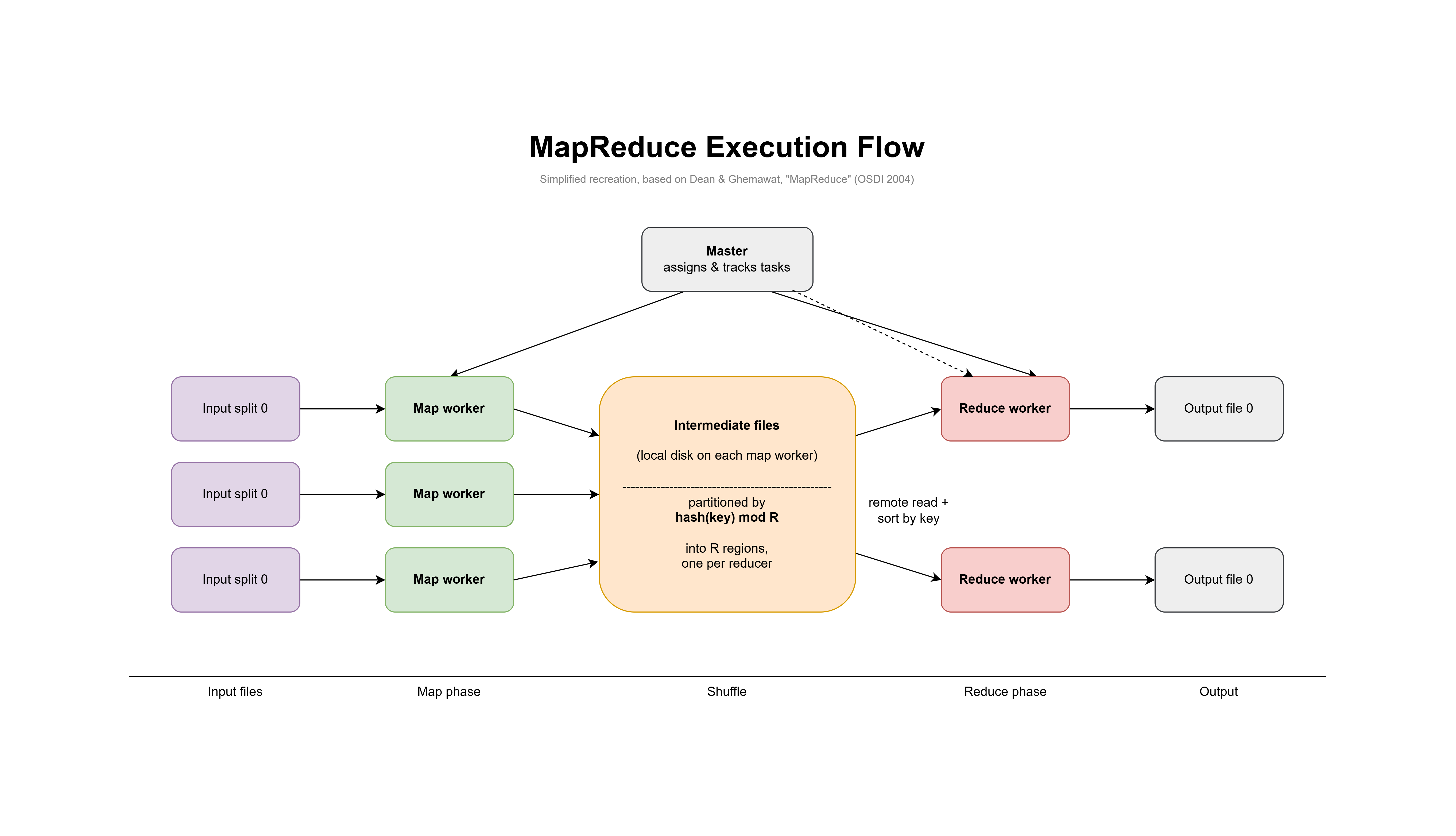
A single master node coordinates everything: it tracks task state (idle / in-progress / completed), knows which worker produced which intermediate file, and pings workers periodically to detect failures.
Key Trade-offs
MapReduce isn't free — it makes explicit trade-offs in exchange for simplicity and fault tolerance:
Restricted programming model, in exchange for automatic parallelism. You can't express arbitrary computation as map + reduce comfortably — anything that needs global, mutable, shared state across records doesn't fit well. In return, you get parallelization and fault tolerance for free.
Local disk writes for intermediate data, in exchange for cheap recovery. Map output goes to local disk instead of streaming directly to reducers. This costs extra I/O but means a failed reducer can just re-read the data later — nothing upstream needs to re-run.
Full re-execution over partial recovery. If a map task's machine dies, the entire task re-runs elsewhere, even if it was 90% done. This is simpler to reason about than fine-grained checkpointing, at the cost of some wasted work.
Network bandwidth vs. local compute. The heavy emphasis on locality-aware scheduling (running map tasks on or near the machine that already holds the data) trades scheduling complexity for saved network bandwidth — which the paper explicitly calls out as the scarcest resource in their cluster.
Backup ("speculative") tasks trade extra compute for lower tail latency. Near the end of a job, the master re-launches remaining slow tasks on other machines and just takes whichever finishes first. This burns a small amount of extra CPU across the cluster to avoid one straggler holding up the entire job.
Failure Cases or Limitations
The paper is refreshingly candid about where the model doesn't hold up cleanly:
Single master, no automatic failover. The master isn't itself made fault-tolerant in this implementation — if it dies, the whole job aborts and the client has to retry. The authors judged this acceptable because a single machine failing is rare, but it's a real single point of failure.
Non-deterministic map/reduce functions produce weaker guarantees. If your
maporreduceisn't deterministic, different reduce tasks can end up seeing results from different executions of the same map task, so outputs across reduce partitions may not be mutually consistent.Stragglers are mitigated, not eliminated. Backup tasks help a lot, but they're a band-aid over the root cause (heterogeneous or degraded hardware), not a structural fix.
Poor fit for iterative or low-latency workloads. MapReduce is built around whole-dataset batch jobs with disk-based intermediate storage — it wasn't designed for tight iterative loops (e.g. many ML training algorithms) or for interactive, low-latency queries. This is precisely the gap that systems like Spark exploited a decade later by keeping intermediate data in memory.
Coarse task granularity has real memory costs. The master keeps
O(M × R)state in memory for scheduling, which puts a practical ceiling on how largeMandRcan grow, even though the paper's own workloads (M = 200,000, R = 5,000) push this fairly hard.
What Modern Engineers Can Learn
Even if you'll probably never write a MapReduce job by hand again, the underlying lessons show up everywhere in distributed systems design:
Separate the "what" from the "how." Whenever you can express a computation as a small number of pure, stateless functions, you make parallelization and fault tolerance a solved problem instead of a per-project reinvention.
Idempotent, re-runnable units of work are cheaper than perfect state tracking. "If it fails, just redo the whole unit" is often a better engineering trade-off than fine-grained checkpointing, especially early on.
Data locality is often the real bottleneck, not compute. Moving computation to data (rather than data to computation) remains the right default whenever bandwidth is scarcer than CPU.
Tail latency deserves its own mitigation strategy. Backup/speculative execution is a pattern worth remembering any time you have many parallel workers and one slow one can block the whole job.
Design for the failure mode that will actually happen. At Google's scale in 2004, "a machine will die during this job" wasn't a hypothetical — it was expected. The system was designed around that reality rather than treating failure as exceptional.
How This Maps to AWS / Kubernetes / DevOps
If you work with modern cloud infrastructure, you're already living inside descendants of this paper's ideas, even if you've never opened a MapReduce job:
AWS EMR, Google Dataproc, and Hadoop/Spark clusters are direct, productized descendants of this exact model — split, map, shuffle, reduce, all managed for you.
The master/worker split maps almost one-to-one onto Kubernetes' control plane and nodes. The Kubernetes control plane tracks the state of every pod (idle/running/failed) the same way the MapReduce master tracks map/reduce tasks, and reschedules failed pods elsewhere — conceptually the same "detect failure, redo the unit of work" pattern.
Backup tasks are the ancestor of things like Kubernetes' pod anti-affinity and multi-replica scheduling, and more directly, of speculative retries used in serverless and batch systems (AWS Batch, Step Functions retries) to fight tail latency from a single slow node.
Locality-aware scheduling shows up in Kubernetes node affinity/topology-aware routing and in cloud storage design generally (e.g., keeping compute in the same availability zone as the data it reads, to avoid cross-AZ network costs).
Idempotent task re-execution is the same philosophy behind CI/CD pipeline retries and container restarts — instead of trying to resume a broken deployment mid-way, most systems just re-run the failed step or the whole job.
If you're designing your own distributed job system today, you'll almost certainly re-derive some version of: split work into small units, track state centrally, re-run failed units elsewhere, keep data and compute close together, and give slow stragglers a way to be overtaken. That's MapReduce's real legacy — not the specific API, but the shape of the solution.
Next up in this series: BigTable. If you want to go deeper, read the full paper here — Section 5 in particular has the original performance graphs for the grep and sort benchmarks that are worth seeing directly.
